Detailed N10-009 Answers & N10-009 Relevant Questions
Wiki Article
2026 Latest Real4test N10-009 copyright and N10-009 copyright Free Share: https://drive.google.com/open?id=1ZAVhuw6blnGdcXJ4mBJIKJJVsExNNDOB
We should admit that gaining the N10-009 test certification will bring your some benefits. You may get a good opportunity in the job interview due to your CompTIA N10-009 exam certification. You may have a promotion in your present job and get a considerable salary. So, no matter how difficult it is, many IT candidates still choose to take the N10-009 exam test. Real4test CompTIA latest practice exam test may contribute to your N10-009 Exam Preparation. We have three different versions for you to choose, the PDF, PC Test Engine, Online Test Engine. You can choose the proper version according to your actual condition. CompTIA N10-009 exam torrents are valid and useful which can ensure you 100% pass in the actual test.
The time and energy are all very important for the office workers. In order to get the N10-009 certification with the less time and energy investment, you need a useful and valid N10-009 study material for your preparation. N10-009 free download pdf will be the right material you find. The comprehensive contents of N10-009 practice torrent can satisfied your needs and help you solve the problem in the actual test easily. Now, choose our N10-009 study practice, you will get high scores.
>> Detailed N10-009 Answers <<
Free PDF CompTIA - Professional N10-009 - Detailed CompTIA Network+ Certification Exam Answers
Our team regularly modified it to provide you with the real and updated N10-009 pdf exam questions every time. The applicants are informed of these new changes till three months after purchase from the Real4test. The Real4test gives its applicants a CompTIA N10-009 web-based practice test software that doesn't require installation. CompTIA N10-009 Practice Test is compatible with all operating systems, including iOS, Mac, and Windows. You can use this CompTIA N10-009 practice test on any browser on any device anywhere. You need to sign in to a verified account on our website to use the entire premium CompTIA N10-009 practice test questions.
CompTIA N10-009 Exam Syllabus Topics:
| Topic | Details |
|---|---|
| Topic 1 |
|
| Topic 2 |
|
| Topic 3 |
|
CompTIA Network+ Certification Exam Sample Questions (Q83-Q88):
NEW QUESTION # 83
A network administrator has been tasked with configuring a network for a new corporate office. The office consists of two buildings, separated by 50 feet with no physical connectivity. The configuration must meet the following requirements:
. Devices in both buildings should be
able to access the Internet.
. Security insists that all Internet traffic
be inspected before entering the
network.
. Desktops should not see traffic
destined for other devices.
INSTRUCTIONS
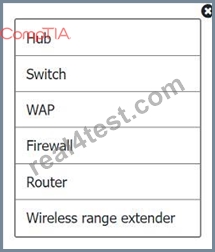
Select the appropriate network device for each location. If applicable, click on the magnifying glass next to any device which may require configuration updates and make any necessary changes.
Not all devices will be used, but all locations should be filled.
If at any time you would like to bring back the initial state of the simulation, please click the Reset All button.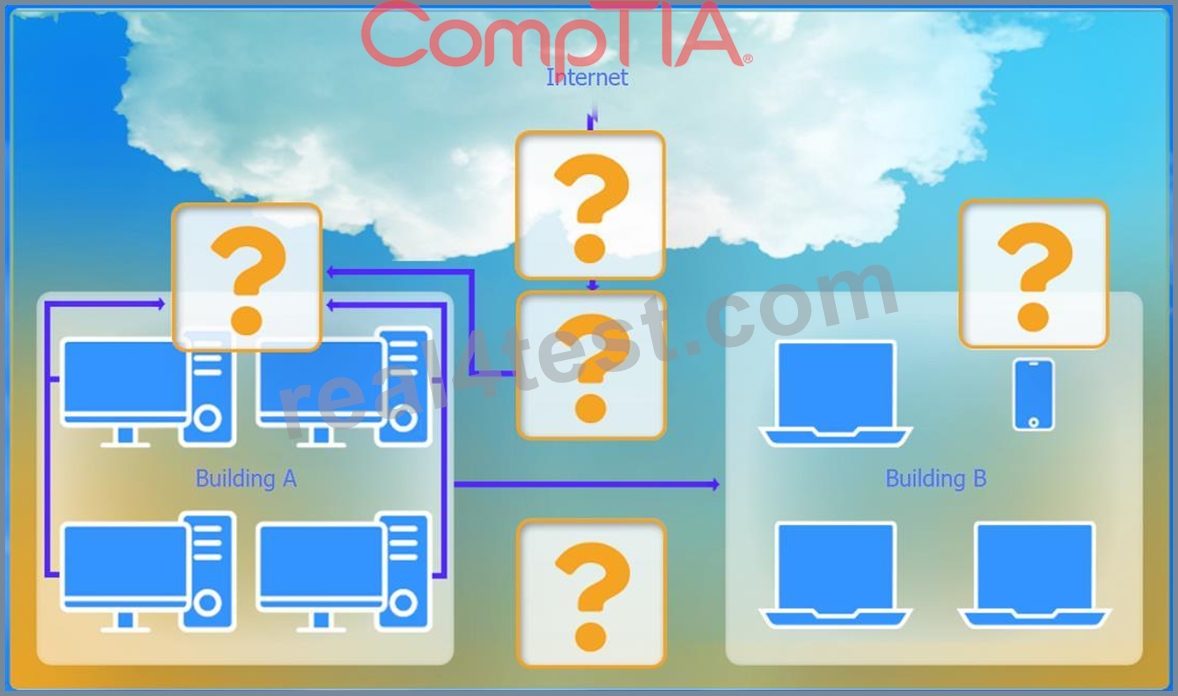
Answer:
Explanation:
See the step by step complete solution below.
Explanation:
* Devices in both buildings should be able to access the Internet.
* Security insists that all Internet traffic be inspected before entering the network.
* Desktops should not see traffic destined for other devices.
Here is the corrected layout with explanation:
* Building A:
* Switch: Correctly placed to connect all desktops.
* Firewall: Correctly placed to inspect all incoming and outgoing traffic.
* Building B:
* Switch: Not needed. Instead, place a Wireless Access Point (WAP) to provide wireless connectivity for laptops and mobile devices.
* Between Buildings:
* Wireless Range Extender: Correctly placed to provide connectivity between the buildings wirelessly.
* Connection to the Internet:
* Router: Correctly placed to connect to the Internet and route traffic between the buildings and the Internet.
* Firewall: The firewall should be placed between the router and the internal network to inspect all traffic before it enters the network.
* Top-left (Building A): Switch
* Bottom-left (Building A): Firewall (inspect traffic before it enters the network)
* Top-middle (Internet connection): Router
* Bottom-middle (between buildings): Wireless Range Extender
* Top-right (Building B): Wireless Access Point (WAP)
Corrected Setup:In this corrected setup, the WAP in Building B will connect wirelessly to the Wireless Range Extender, which is connected to the Router. The Router is connected to the Firewall to ensure all traffic is inspected before it enters the network.
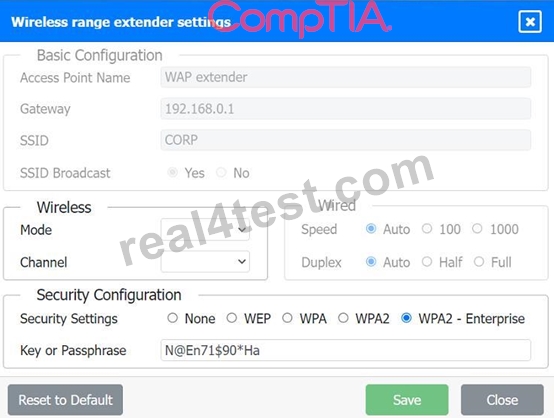
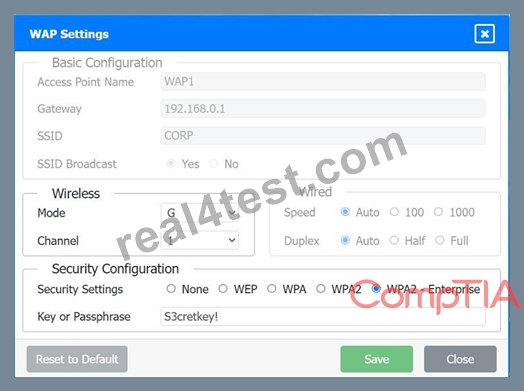
* SSID: CORP
* Security Settings: WPA2 or WPA2 - Enterprise
* Key or Passphrase: [Enter a strong passphrase]
* Mode: [Set based on your network plan]
* Channel: [Set based on your network plan]
* Speed: Auto
* Duplex: Auto
Configuration for Wireless Range Extender:With these settings, both buildings will have secure access to the Internet, and all traffic will be inspected by the firewall before entering the network. Desktops and other devices will not see traffic intended for others, maintaining the required security and privacy.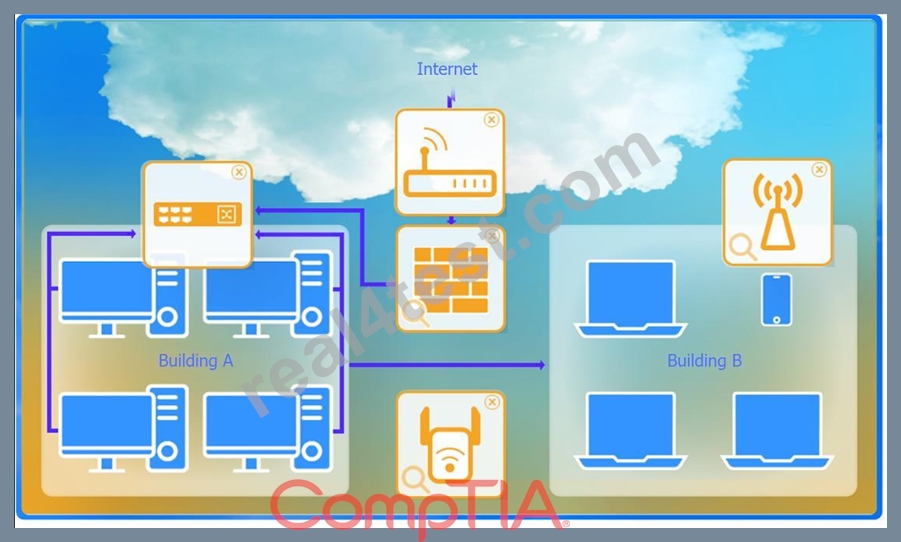
To configure the wireless range extender for security, follow these steps:
* SSID (Service Set Identifier):
* Ensure the SSID is set to "CORP" as shown in the exhibit.
* Security Settings:
* WPA2 or WPA2 - Enterprise: Choose one of these options for stronger security.
WPA2-Enterprise provides more robust security with centralized authentication, which is ideal for a corporate environment.
* Key or Passphrase:
* If you select WPA2, enter a strong passphrase in the "Key or Passphrase" field.
* If you select WPA2 - Enterprise, you will need to configure additional settings for authentication servers, such as RADIUS, which is not shown in the exhibit.
* Wireless Mode and Channel:
* Set the appropriate mode and channel based on your network design and the environment to avoid interference. These settings are not specified in the exhibit, so set them according to your network plan.
* Wired Speed and Duplex:
* Set the speed to "Auto" unless you have specific requirements for 100 or 1000 Mbps.
* Set the duplex to "Auto" unless you need to specify half or full duplex based on your network equipment.
* Save Configuration:
* After making the necessary changes, click the "Save" button to apply the settings.
Here is how the configuration should look after adjustments:
* SSID: CORP
* Security Settings: WPA2 or WPA2 - Enterprise
* Key or Passphrase: [Enter a strong passphrase]
* Mode: [Set based on your network plan]
* Channel: [Set based on your network plan]
* Speed: Auto
* Duplex: Auto
Once these settings are configured, your wireless range extender will provide secure connectivity for devices in both buildings.
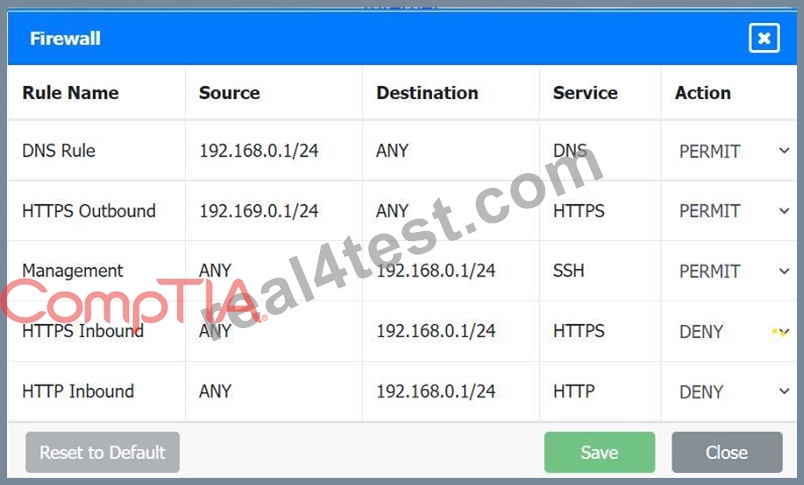
Firewall setting to to ensure complete compliance with the requirements and best security practices, consider the following adjustments and additions:
* DNS Rule: This rule allows DNS traffic from the internal network to any destination, which is fine.
* HTTPS Outbound: This rule allows HTTPS traffic from the internal network (assuming
192.169.0.1/24 is a typo and should be 192.168.0.1/24) to any destination, which is also good for secure
* web browsing.
* Management: This rule allows SSH access to the firewall for management purposes, which is necessary for administrative tasks.
* HTTPS Inbound: This rule denies inbound HTTPS traffic to the internal network, which is good unless you have a web server that needs to be accessible from the internet.
* HTTP Inbound: This rule denies inbound HTTP traffic to the internal network, which is correct for security purposes.
* Permit General Outbound Traffic: Allow general outbound traffic for web access, email, etc.
* Block All Other Traffic: Ensure that all other traffic is blocked to prevent unauthorized access.
* Correct the Network Typo:
* Ensure that the subnet 192.169.0.1/24 is corrected to 192.168.0.1/24.
* Permit General Outbound Traffic:
* Rule Name: General Outbound
* Source: 192.168.0.1/24
* Destination: ANY
* Service: ANY
* Action: PERMIT
* Deny All Other Traffic:
* Rule Name: Block All
* Source: ANY
* Destination: ANY
* Service: ANY
* Action: DENY
Suggested Additional Settings:Firewall Configuration Adjustments:Here is how your updated firewall settings should look:
Rule Name
Source
Destination
Service
Action
DNS Rule
192.168.0.1/24
ANY
DNS
PERMIT
HTTPS Outbound
192.168.0.1/24
ANY
HTTPS
PERMIT
Management
ANY
192.168.0.1/24
SSH
PERMIT
HTTPS Inbound
ANY
192.168.0.1/24
HTTPS
DENY
HTTP Inbound
ANY
192.168.0.1/24
HTTP
DENY
General Outbound
192.168.0.1/24
ANY
ANY
PERMIT
Block All
ANY
ANY
ANY
DENY
These settings ensure that:
* Internal devices can access DNS and HTTPS services externally.
* Management access via SSH is permitted.
* Inbound HTTP and HTTPS traffic is denied unless otherwise specified.
* General outbound traffic is allowed.
* All other traffic is blocked by default, ensuring a secure environment.
Make sure to save the settings after making these adjustments.
NEW QUESTION # 84
A research facility is expecting to see an exponential increase in global network traffic in the near future. The offices are equipped with 2.5Gbps fiber connections from the ISP, but the facility is currently only utilizing
1Gbps connections. Which of the following would need to be configured in order to use the ISP's connection speed?
- A. Link aggregation
- B. 802.1Q tagging
- C. Network address translation
- D. Port duplex
Answer: A
Explanation:
* Understanding Link Aggregation:
* Definition: Link aggregation combines multiple network connections into a single logical link to increase bandwidth and provide redundancy.
* Usage in High-Bandwidth Scenarios:
* Combining Links: By aggregating multiple 1Gbps connections, the facility can utilize the full 2.5 Gbps bandwidth provided by the ISP.
* Benefits: Enhanced throughput, load balancing, and redundancy, ensuring better utilization of available bandwidth.
* Comparison with Other Options:
* 802.1Q Tagging: Used for VLAN tagging, which does not affect the physical bandwidth utilization.
* Network Address Translation (NAT): Used for IP address translation, not related to link speed or bandwidth aggregation.
* Port Duplex: Refers to the mode of communication (full or half duplex) on a port, not the aggregation of bandwidth.
* Implementation:
* Configure link aggregation (often referred to as LACP - Link Aggregation Control Protocol) on network devices to combine multiple physical links into one logical link.
NEW QUESTION # 85
A network engineer configures the network settings in a new server as follows:
* IP address = 192.163.1.15
* Subnet mask = 255.255.255.0
* Gateway = 192.163.1.255
The server can reach other hosts on the same subnet successfully, but it cannot reach hosts on different subnets. Which of the following is most likely configured incorrectly?
- A. Subnet mask
- B. Gateway
- C. Default route
- D. IP address
Answer: B
Explanation:
The default gateway for a network should bean IP address within the subnet, butnot the broadcast address
. In this case:
* IP: 192.163.1.15
* Subnet Mask: 255.255.255.0
* This means thenetwork rangeis: 192.163.1.0 - 192.163.1.255
* 192.163.1.255 is thebroadcast addressfor this subnet, so itcannot be used as a gateway.
Hence, the device fails to communicate outside its subnet because it's trying to use abroadcast addressas its gateway.
#The issue is clearly with thegateway configuration.
NEW QUESTION # 86
What is the most likely way to improve throughput during large file transfers like backups?
- A. QoS
- B. TTL
- C. SDN
- D. VXLAN
- E. MTU
Answer: E
Explanation:
Increasing the MTU (Maximum Transmission Unit) size allows larger frames to be transmitted, reducing overhead and improving throughput - especially for large file transfers like backups.
* A. QoS prioritizes traffic but doesn't reduce backup times directly.
* B. SDN is a network management model, not a parameter change.
* D. VXLAN encapsulates VLANs, not relevant to backup speeds.
* E. TTL is for packet lifetime, not throughput.
References (CompTIA Network+ N10-009):
* Domain: Network Infrastructure - MTU, jumbo frames, performance tuning.
NEW QUESTION # 87
Which of the following is the MOST appropriate solution to extend the network to a building located across the street from the main facility?
- A. Cat 6 copper
- B. Loopback adapter
- C. Multimode fiber
- D. 802.11ac wireless bridge
Answer: D
NEW QUESTION # 88
......
Our N10-009 exam questions are valuable and useful and if you buy our N10-009 study materials will provide first-rate service to you to make you satisfied. We provide not only the free download and try out of the N10-009 Practice Guide but also the immediate download after your purchase successfully. To see whether our N10-009 training dumps are worthy to buy, you can have a try on our product right now.
N10-009 Relevant Questions: https://www.real4test.com/N10-009_real-exam.html
- 100% Pass 2026 CompTIA N10-009 The Best Detailed Answers ???? Easily obtain free download of ☀ N10-009 ️☀️ by searching on ▛ www.practicevce.com ▟ ????N10-009 Exam Quizzes
- Reliable N10-009 Exam Topics ???? Reliable N10-009 Test Guide ???? N10-009 Dumps Free Download ???? Search for ☀ N10-009 ️☀️ and download it for free on ⏩ www.pdfvce.com ⏪ website ????Detailed N10-009 Study Dumps
- CompTIA Realistic Detailed N10-009 Answers 100% Pass Quiz ???? Copy URL ⇛ www.prep4away.com ⇚ open and search for ➥ N10-009 ???? to download for free ????N10-009 Passed
- Best way to practice test for CompTIA N10-009? ???? Search for 《 N10-009 》 and download it for free on ➡ www.pdfvce.com ️⬅️ website ↪Valid N10-009 Test Questions
- Key N10-009 Concepts ???? N10-009 Reliable Exam Practice ???? N10-009 Upgrade Dumps ???? Search for ➡ N10-009 ️⬅️ and download exam materials for free through ➠ www.pdfdumps.com ???? ????N10-009 Accurate Study Material
- Valid N10-009 Test Questions ???? N10-009 Accurate Study Material ⏪ Reliable N10-009 Exam Topics ???? Search for ➡ N10-009 ️⬅️ and download exam materials for free through 「 www.pdfvce.com 」 ????Practice N10-009 Exams Free
- 2026 Detailed N10-009 Answers | High Hit-Rate 100% Free CompTIA Network+ Certification Exam Relevant Questions ???? Search on ➠ www.dumpsmaterials.com ???? for ▛ N10-009 ▟ to obtain exam materials for free download ????N10-009 New Learning Materials
- Quiz 2026 N10-009: Valid Detailed CompTIA Network+ Certification Exam Answers ???? Search for ➥ N10-009 ???? on { www.pdfvce.com } immediately to obtain a free download ????N10-009 Detailed Study Plan
- Reliable N10-009 Test Guide ???? N10-009 Passed ???? Valid N10-009 Exam Pattern ???? Easily obtain free download of 【 N10-009 】 by searching on ( www.practicevce.com ) ????Reliable N10-009 Test Guide
- Valid N10-009 Test Questions ???? N10-009 Exam Labs ???? N10-009 Reliable Exam Question ???? Enter ➠ www.pdfvce.com ???? and search for ☀ N10-009 ️☀️ to download for free ????N10-009 Detailed Study Plan
- N10-009 Detailed Study Plan ???? N10-009 New Learning Materials ???? N10-009 New Learning Materials ???? Search for { N10-009 } and download it for free on [ www.vce4dumps.com ] website ????N10-009 New Learning Materials
- kalefrlr129162.angelinsblog.com, joycecvxh582631.activoblog.com, alphabookmarking.com, pennyxzho932765.blog2freedom.com, emiliagpyp497081.livebloggs.com, www.stes.tyc.edu.tw, flynnagql759829.idblogmaker.com, listedirectory.com, bookmarkshome.com, fannienmso234360.bimmwiki.com, Disposable vapes
DOWNLOAD the newest Real4test N10-009 copyright from Cloud Storage for free: https://drive.google.com/open?id=1ZAVhuw6blnGdcXJ4mBJIKJJVsExNNDOB
Report this wiki page